Tuesday, January 1, 2013

All-Star Comics #17 - "The Brain Wave Goes Berzerk"

While cover dated for June-July of 1943, as was often the case with comic books (and still is today), the dates on the cover served more as a notice to newsstands as to how long that particular issue should remain on the stand.

With that said, lets estimate this as actually coming out a few months prior. That would mean the Allied forces of World War II were working on squeezing the Germans out of Tunisia at the time, Japanese aircraft were bombing Darwin, Australia, and British Prime Minister Winston Churchill was addressing a joint session of the United States Congress.

While the tone of what was going on in the world was present amid heroes, villains, and citizens, this 1943 tale stays on American soil, keeping the heroes battling for safety on the home front.

They do so against their first-ever recurring villain, The Brain Wave. As I've mentioned before, up to this point, the Justice Society fought spies, saboteurs and crime syndicates in every issue. The Brain Wave's appearance two issues prior marked what has now become expected of any super-hero team, super villains to challenge their heroic abilities.

This adventure starts out with what just feels like one of the most mundane crimes of the century, as blurted out by Wonder Woman in the very first panel.


the crime of the century?


This one just really makes me chuckle, but it emphasizes just how much the 1940s era of the Justice Society was like a club or social group. I once belonged to an organization that had been in existence since the 1920s, and being as they were very big on keeping up their routines and procedures the same way as they had since their inception, I could totally see someone running into a meeting with that much urgency and screaming "the past minutes have been stolen!"

It turns out the minutes have been stolen by Henry King, the criminal known as "The Brain Wave" as a way to read up on the heroes that left him to his death several months prior. While it appeared Brain Wave had fallen to his death from the tower of his hideout, he, in a very Harold Lloyd-esque manner, snagged his robe on a wooden beam, saving his life. Naturally, like any super-villain, he's out for revenge, and in this case, well, he explains it best...

Just throw science out the window and go with it, folks.

It works, and before long, Brain Wave has managed to shrink the JSA members (except for Wonder Woman who ran home to make sure she didn't leave the minutes there) to eight inches. He then places each of the heroes inside little bird cages, and puts them on display in his hideout. Rather than killing them right off the bat, though, Brain Wave sends out his minions to each pull off a different crime, one that he is sure will be pulled off with the JSA under his nose. What he doesn't count on, though, is Hawkman calling about an army of birds to carry the cages away, the Justice Society intent on stopping this series of crimes, even at only eight inches tall.

Hawkman's adventure is first up and he finds himself falling into the hands of a young boy, who is playing outside when he comes across the now pint-sized hero. Immediately recognizing him as Hawkman, but mistaking him for a toy, the by takes the winged warrior home. It turns out to be a good move because, the boy's father is rich, you see, and like some twisted Babes in Toyland, some of the boy's other toys seemingly come to life in an effort to rob the family. Those other toys, it turns out, are henchmen of Brain Wave and upon enlarging themselves to regular size, find that even a tiny Hawkman is a force to be reckoned with. Defeating the terrible toymen, Hawkman is then quickly swept up by Johnny Thunder's Thunderbolt and whisked away to parts unknown.
 
You have to read this with an Irish brogue. There is no other way. Begorah!

The Sandman, meanwhile, has been deposited by the birds into a forest with trees covered in dollar bills. As if that weren't weird enough, Sandman discovers each of the bills has instructions of some sort written on them. It appears this is the way Brain Wave communicates some of his plans to a particular group of lackeys who will be attempting to rob a jewelry store this evening. Well, even a pint-sized Sandman is a force to be reckoned with. The miniature hero commandeers a vehicle and follows the crooks, where he puts an end to their heist, just before being swept up by the Thunderbolt as well.

Universal power but can't enlarge himself.
Oh, Spectre. I will never understand how you are the "vengeful hand of God," an all-powerful supernatural being, yet too often are susceptible to the machinations of earthly supervillains and their devices. In this case, Spectre, who has time after time again, changed his size to massive proportions at will and flown to the ends of the universe on a whim, has somehow been affected by Brain Wave's device and also shrunken down to eight inches tall. It does not stop him, though, from stopping a crime before being swept up by the Thunderbolt like the other JSAers. Honestly, nothing quite exciting here.

The same goes for Dr. Fate, whose sorcerer abilities seem to have been forgotten by the writers once again in favor of putting him in the same trouble as any other hero. Comic historians claim that Fate (and I'm guessing the Spectre) had their other-worldly, supernatural and magical elements toned down (or in some cases wiped out) during this period in order to avoid being seen as promoting black magic and the macabre. Here, Dr. Fate does little more than any other interchangeable hero by foiling a bank robbery.

Brain Wave must have really been pretty loose with talking about every detail of his plans in front of the miniaturized JSA, because it seems each member picked up specifically where, when and what this plethora of schemes were happening.
how much spent printing newspapers for this scheme?!

Dr. MidNite gets dropped off (man these birds listen well to these tiny beings in a cage) at a wealthy person's house just at the same time a rough looking figure is stealing the man's newspaper and swapping out for a fake.

The scheme here is planting fake newspapers with stories about people being threatened by a particular gang and how police advise victims to pay up to the gang.

Naturally, MidNite exposes the scheme for what it is, foiling the Brain Wave once again before begin snatched up by the Thunderbolt.


It's hard not to wonder how much time and money was spent on equipment, materials, and manpower to create complete fake newspapers, with fully-written articles within. Brain Wave probably spent as much on publishing as they were stealing from these folks to begin with. Not to mention the money spent on this next scheme.

Brain Wave even spent money on a circus
Tiny Starman goes to the circus. Or at least he tries. The scheme Starman has stumbled onto has the Brain Wave's men bringing a circus to town, and in this Depression-era, what better way to draw people form their homes and businesses than with a free day at the circus. With most of the population abandoning the town, it's ripe for the picking, and the Brain Wave's lackeys give it their best shot, only to be stopped by the miniature man of the stars.


The Atom gets dropped off in Keystone City (which will become the future home of Jay Garrick, The Flash) where he finds men purposely getting injured in a variety of ways, whether it be throwing themselves in front of a bus or off of ladders. It all seems quite bizarre, until The tiny Atom finds out all the men brought to the hospital are criminals. It is all part of Brain Wave's scheme to rob the hospital of radium inside the safe. His men already past security and inside, they pick up firearms that were planted earlier and get to work. But, the Atom gets to work too, and used to being smaller than his average foe, puts a stop to the scheme, even at eight inches tall.  Of course, he too, ends up scooped up by the Thunderbolt in an effort to aid Johnny Thunder.

A majority of the JSA's missions had to do with robberies or break-ins. It's sort of surprising that it's goofball Johnny Thunder's mission that is the darkest and most dire. The Brain Wave has a lackey who has been training for months to learn the attributes, inflection and life of one Senator Graves, as well as taking on his appearance. Now, the Brain Wave plans on substituting the Senator with his double and take over the Senator's wealth, power and influence. What to do with the Senator? The men plan to drown him in his own bath tub!! Like I say, a little dark for a Johnny Thunder adventure.

crime does not pay...enough to afford pants.
Miniature Johnny seems even less effectual than normal with his diminutive size, even being placed in an icebox by the criminals at one point. It seems hopeless, until Johnny realizes he has the power of the magic Thunderbolt on his side, and saying those magic words (Cei U!) returns to normal size, summons the rest of the JSA, and puts an end to the kidnapping/death/impersonation plot.

As the JSA marches onward to Shark Tooth Bay to bring the Brain Wave to justice, the criminal mastermind doesn't plan on coming along easily, and actually wants the JSA to come, as he has lined the outside of his compound with explosives, ready to detonate.

However, the sudden appearance of the genie-like Thunderbolt inside the Brain Wave's headquarters throws the evil genius for a stammering loop, sending him into a tizzy and frantically setting off the detonator.

Little does Brain Wave suspect, however, that Thunderbolt moved all the explosives under the tower at Shark Tooth Bay, sending the criminal's hideout (and supposedly the genius himself) up into a blast of fiery debris.


The story itself was nothing groundbreaking. The Justice Society has certainly been through adventures with a little more depth, but lets not forget the audience this was aimed at - young children under the age of 14 back in the 1940s. "Too absurd" wasn't really in the vernacular, and some of Gardner Fox's scripts certainly pushed that to the limit.

As I've mentioned earlier, though, the issue is significant in and of itself in comic lore for having the first recurring villain for the Justice Society (who were, themselves history's first team of super heroes), even if that villain was a bald man in a robe and slippers.

Monday, October 1, 2012

All Star Comics #16 - "The Justice Society Fights for a United America"

It's Spring 1943 and Hitler is at it again. Feeling the pinch from American forces (and the Justice Society), he sets out on a plan to attack America from the inside - by having Nazi spies infiltrate the United States and start convincing people that those they've trusted are taking advantage of them.

It starts at a steel factory not far from Hawkman's territory, where a German bloke named Buehler has managed to get a job at the factory so that he can persuade the workers that the steel factory owner, who has always been kind to them, is making a fortune off of their sweat, and must be taking more than a fair share. An uprising seems evident, until Hawkman, with the aid of two young men (one the steel factory owner's son, the other one of the employees' sons, both best friends since youth) put a squash to it and expose the Nazis plan to bring a halt to steel (and thus armament) production during the war.

The Dr. MidNite tale is a bit more somber than has been customary for the Doc in past issues. The reader is greeted by what looks almost like a spectral version of an old-school gangster named "Tough Tony Scarlotti," who talks about what a terrible youth he was and how he strives for his son, Tony Jr, to be a better person.

What could have quickly devolved into a typical punch-em-up caper is a heartfelt tale about racism in America. Tony Jr has been getting into fights and even taking a black eye or two, but not because he's starting trouble. No, it's because he's been standing up for kids who have been picked on because of their ethnic background.

The prejudiced ideas are being planted into the children's heads by members of the Axis powers, who are working covertly in American to spread hate. That's when Dr. MidNite gets involved (also because Tony Jr is a member of the Junior Justice Society of America, which any kid could join back in the 40s, for a few cents and mailing in the certificate found in the comics The membership materials, including the Junior Justice Society badge are worth hundreds of dollars today).


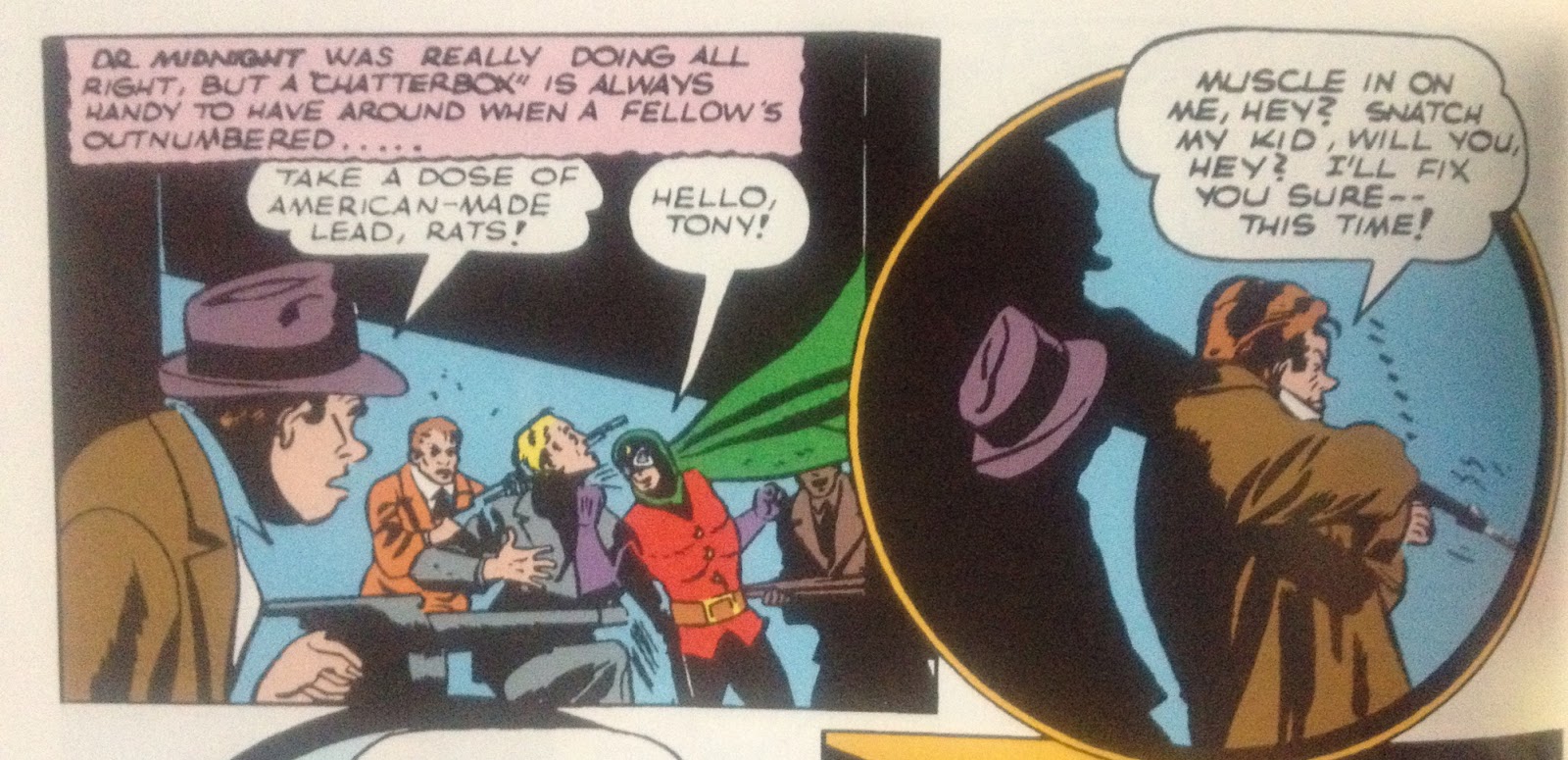
When the spreaders of hate-filled racism find that young Tony is trying to teach the neighborhood kids better, they decide it's time to get the little squirt out of the way, kidnapping him. While he's eventually rescued by Dr. MidNite, rats kidnapping his son does not set well with Tough Tony, who pulls out his old "chatterbox" and drops in as Dr. MidNite tangles with the enemy.


Of course, Tony ends up a bit in over his head, and finds himself on the other end of the gun for a change. He dies, but as he tells both Dr MidNite and the reader, he's dying happy, knowing the boy he raised is a better man than he.


Written by Gardner Fox and drawn by Stan Asch (the same guy who handles art chores on Johnny Thunder), this short tale really holds up today, delivering compassionate thoughts on where the country stands with its melting pot status, and how words of hate can quickly turn to violence and death. Definitely a stand out.

The Atom finds himself also at odds with those who wish to spread messages of hate and intolerance across America (noticing a theme yet?), only he is dealing with the workers of a coal mine.

In fact, the story opens with the Atom single-handedly propping a mine shaft on the verge of collapse. As the miners rush to safety, the mine gives way and The Atom, tapped beneath the rubble, recalls how he got into this mess.

The son of one of the miners (also a member of the Junior Justice Society) informs the Atom that his father and other workers are being told that the mine's owners, because they are foreigners, don't care at all about the workers and that the mine's are a dangerous place for them to be working. They want the workers to turn against the owners, solely on the base of what country they were born.

While the workers, at first, don't buy into the propaganda, once The Atom addresses the crowd about the safe conditions and not judging people by their birthplace, the propaganda artists decide to set off explosions in the mine and prove their point.

Bringing us to the present, The Atom is thought to be dead by the miners, who are starting to believe the hate-message about the mine's owners. That is, until The Atom, who managed to survive, comes forth and lets the workers know who was really behind the explosion.

Dr. Fate's got a mystical foe on his hands, or so that foe would like the public to believe. A so-called prophet calling himself "Mr. Fortune" blows into town in a nice suit and turban, reading fortunes and giving residents a glimpse of what's to come. When the incidents start to actually happen, the town goes into a panic, and is ready to do anything Mr. Fortune tells them.

Of course, this turns out to be nothing but a ruse. Once Mr. Fortune builds the public's confidence in himself, he can spread the hate of the Axis Powers, his true intention after all. When Dr. Fate tries to intervene, the public turns on the hero, taking Mr. Fortune for his word that Dr. Fate is "un-American."

Naturally, all goes well in the end and Mr. Fortune is exposed as a fraud, but I can't help but mention how much I dug the name of "Mr. Fortune" as a villain. Sure, his look was typical 1940s villain (a suit), with the addition of the turban, but something about it just worked for the Golden Age.

I also have to wonder if his look helped inspire the character of "Sir Swami" from the Justice League animated series (by Bruce Timm, Paul Dini, Alan Burnett, James Tucker, Dwayne McDuffie and company), in an episode that put the League in an alternate dimension with clean-cut heroes and villains that slightly resembled the heroes and rogues of the Justice Society stories of the 40s. In this case, Sir Swami was a stand-in for JSA villain, "the Wizard," but his look certainly seems to come heavily from Mr. Fortune.

Alas, as interesting as he is in a very simplistic way, I've yet to find reference to any other appearances by Mr. Fortune with the JSA or Dr. Fate.

The Sandman, meanwhile, is haunting the dreams of Henry Overman, the publisher of a newspaper called "The New Way," meaning a confrontation between the two will soon come to pass. Once again, beautiful art by Joe Simon and Jack Kirby.

Using his newspaper, Overman, working for Hitler and the Third Reich, is publishing false articles, supposedly by "experts" that state the American forces are in pretty bad shape when it comes to the war, and are facing a losing battle.

Overman hopes this will raise doubt in American citizens and stop them from buying war bonds to support the forces.


With the help of the newsies who didn't realize they were on the street peddling a Nazi paper, The Sandman brings the publication to a halt.In the end, the newsies realize they all come from different ethnic backgrounds and get along fine, so why should it make any difference in other parts of life?

Starman finds himself in a similar boat, racing to the midwest to get to the bottom of a near-revolt by America's farmers. It seems some strangers have blown into town and planted the bug into their ears that they should be getting paid more for their crops, and that the middlemen and the shops are taking far more than they deserve.
 
Just to be clear, this is a very real problem, even in today's world, where farmer's receive far too little for the necessary crops they grow and provide our dinner tables with. I have a great admiration for the work farmers too, but also a great sympathy for the way they are treated or poorly compensated for such a necessity.

On the night of a vote by the farmers to decide whether or not to stop growing, Starman intervenes and reveals the new men in town as nothing more than Nazi propaganda artists. Seeing that they were being duped by Nazis who hoped to damage the American crops, and morale at home and on the front lines, the farmers decide it's best during the course of WWII to keep things running as-is for the greater good.

In another factory, elsewhere in the country, another troublemaker has broken into the company safe to steal secret documents with the sole intention of planting them on someone of an ethnic background to create friction. Posing as a factory worker and befriending a man name Jan Seybowsy, the Axis spy has found his target. Planting the stolen documents on Jan, the rest of the factory workers quickly turn against him and open their ears to what this stranger has to say. When The Spectre gets word of this, he spirits the evildoers away to the far reaches of space, and a fiery planet where the Nazi is convinced he's burning in hell. The Spectre even take on the frightening form of Satan to push the villain over the edge.

When the man is returned to earth, he has been so frightened that he tries to contact the mother country by radio. When he does, it's before an audience of factory workers and townspeople brought over by The Spectre, who quickly realize they've made a mistake, running the Nazi muckraker out of town, and apologize to Jan for their quick emotional reaction without thinking.

Johnny Thunder (still wearing his Naval uniform) is on the lookout for the Nazi propaganda culprits when he stumbles into a meeting where he unwittingly (is there ever a time that Johnny does something wittingly?) gets caught up in the discussion and ends up making the propaganda speech himself. When he realizes what he's done and the people who led him down this not-so-rosy path, he and his magic Thunderbolt quickly go to work exposing the truth.

The story wraps with the entire Justice Society making an appearance at a War Bond rally at a theatre, where they introduce the audience to the various hard-working Americans across the country, from the miners, the farmers, the women in the factories, the mothers at home, and more.

Sunday, July 8, 2012

All-Star Comics #15 - "The Man Who Created Images"

Cover dated February-March of 1943, the battle of Stalingrad will come to an end, gasoline and shoe rationing will go into effect, and U.S. General Dwight Eisenhower will be selected to command the U.S. forces in Europe while this book sits on newsstands.

Wonder Woman shows up to the monthly Justice Society meeting, only to find that she's the only one in attendance. Apparently, her duties as Secretary (because why would the JSA want to let the most powerful member do anything but?) includes getting the mail, because she finds letters from each member, dictating why they can't make it to the meeting.

So what does Wonder Woman do?

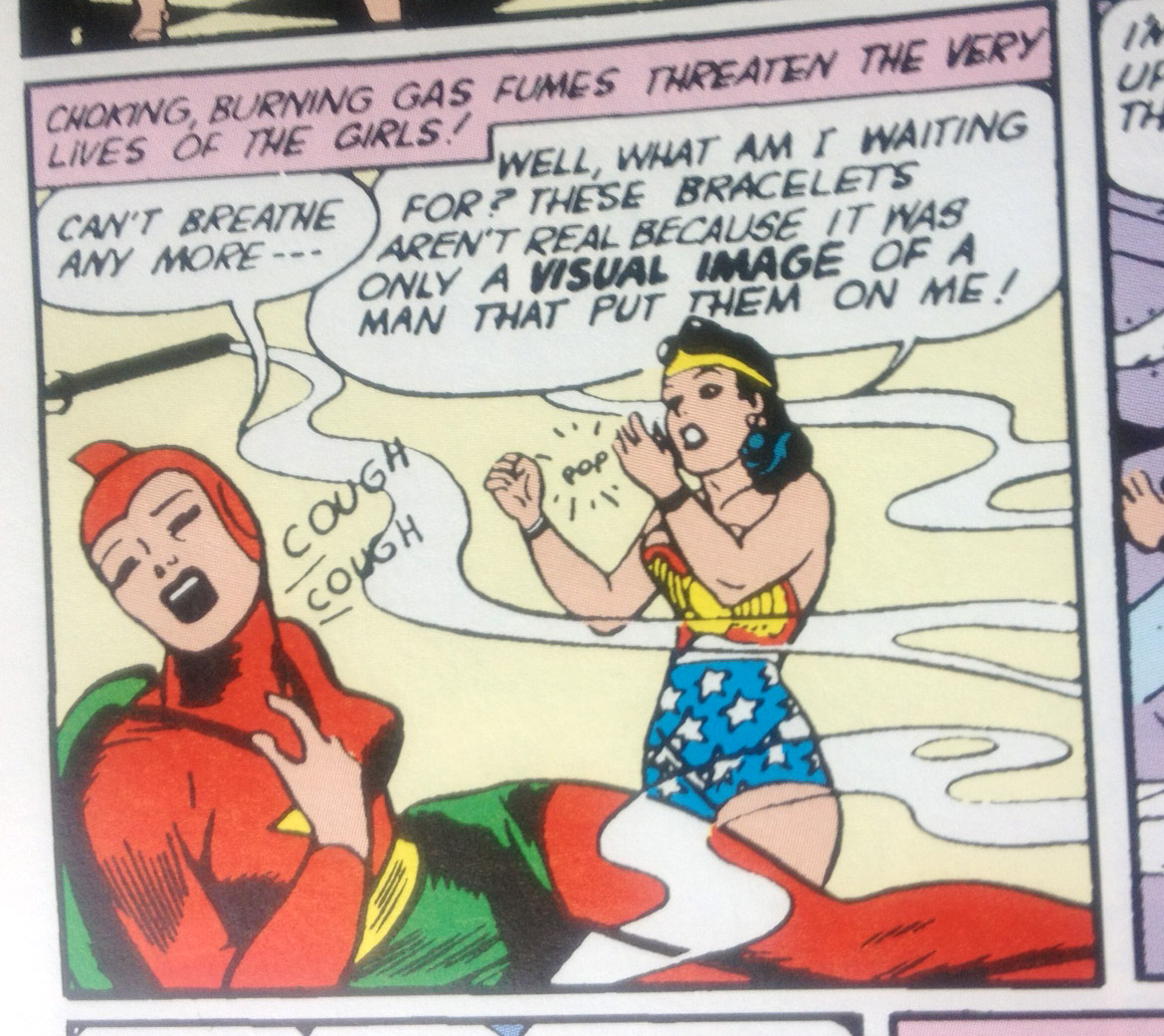
She gathers the girlfriends of each of the JSA members, tells them what's going on, and dresses them up like their boyfriends' costumed identities to launch a rescue.

Because, come on, doing so without the costumes would just be plain silly.

While your sewing abilities are impressive, Wonder Woman, it still begs the question as to why you were making women's versions of JSA costumes in your spare time.
Let's also not forget that most of these women were supposed to be unaware of their beau's nighttime activities, so way to let the cat out of the bag, Wonder Woman.

Meanwhile, the reader learns of the predicament of each JSA member through the letters sent to Wonder Woman. For Hawkman, he was out on the town with girlfriend Shiera when someone is shot dead. Following the underworld gunmen, Hawkman learns that an evil force, known only as The Brain Wave, has even the seediest of gangsters running and scared and doing his bidding.

The same goes for Dr. MidNite, who is brought in under the guise of his everyday identity of Dr. Charles McNider, to treat a sculptor who is convinced that his works of art are coming to life and talking to him. His wife and drunken stooge of a son are looking to have him committed so they can inherit his fortune, but Dr. MidNite proves that the family is in cahoots with gangsters to get that money and get it to this mysterious Brain Wave, who seems to have power and thrall over even the hardest of criminals.

Johnny Thunder (who is dressed in his sailor suit for the first time since we saw all the JSA members enlist under their civilian identities) is raising questions about "The Morrison Museum,' which keeps itself private most of the time, but opens its exhibits to the public four times a year to qualify as a "public museum." In a bit of thinking that I found ahead of itself for a children's comic, the museum has this weird schedule so its owner, Mr. Morrison can qualify as a public museum and not have to pay the taxes a private one would. Also, it's because he uses the museum the rest of the year as a clearing house for stolen items.

With the help of his magic Thunderbolt, Johnny gets a peek at the museum, where he does battle with historic statues that have been brought to life, and even Mr. Morrison himself, who would have shot Johnny dead if not for the Thunderbolt's interference. That's when Johnny learns the real mind behind this scheme is the man known only as "The Brain Wave."

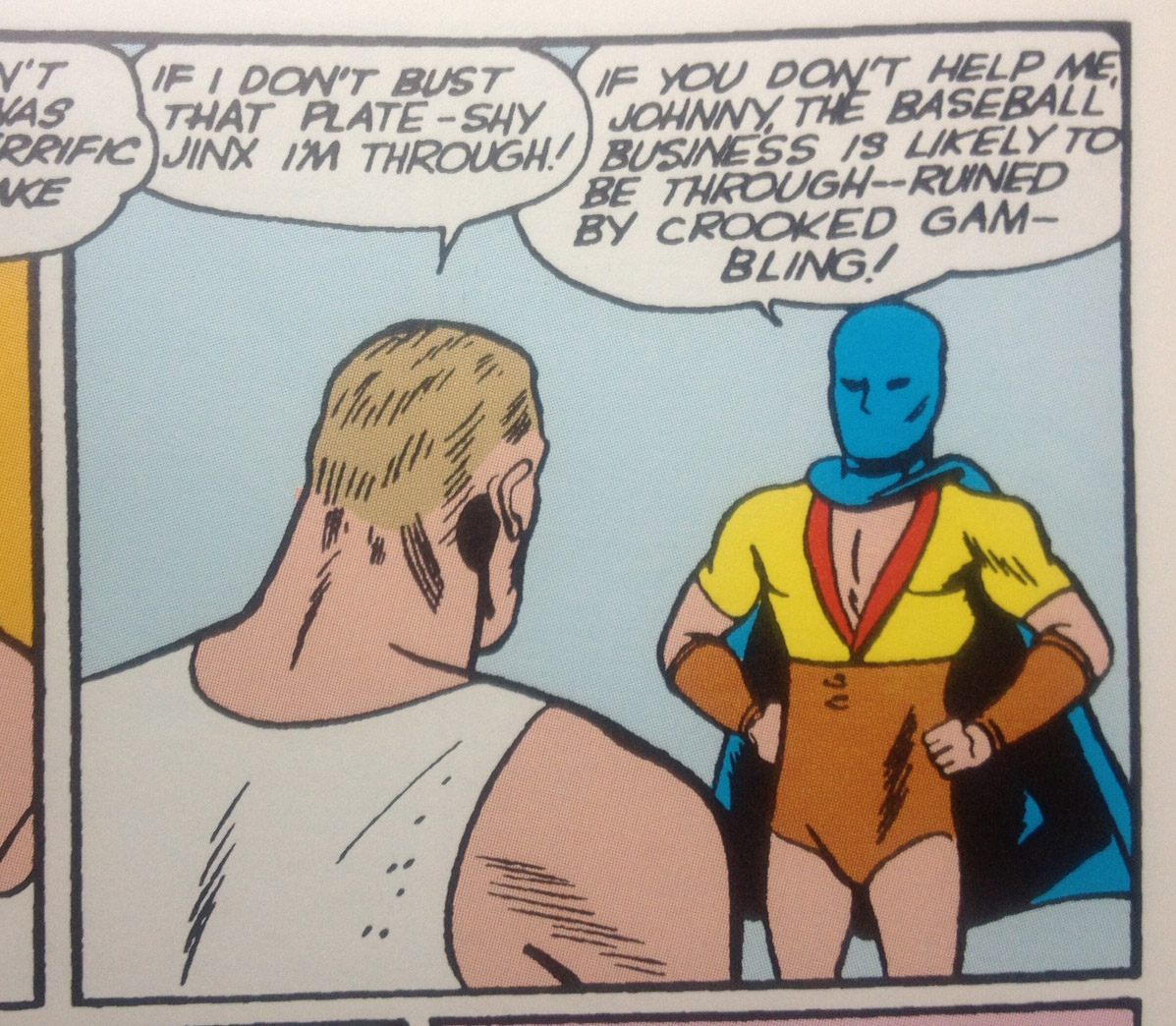
Al Pratt is at a baseball game when he notices that star player Johnny Spartan appears to be throwing the game. Apparently, sporting events require the intervening of super heroes, because Al changes into The Atom and heads into the locker room to have a talk with Johnny.


It seems that Johnny's crooked manager, and a network of criminals is behind the scheme, with Johnny being mentally crippled from making the hits during the game. A little snooping around the manager and his cronies, and The Atom learns it's also the work of The Brain Wave, and heads to Sharktooth Bay (the alleged hideout of this criminal) to find out more.

The Sandman usually is found haunting the dreams of criminals deep in the night, but this time, he appears to be shaking down both the rich (both criminal and legit) in their bedrooms. However, something is not quite right when The Sandman appears before millionaire Wesley Dodds telling him to fork over protection money.

When he overhears another wealthy socialite (albeit a well-known crooked one) complaining of The Sandman's shakedown, Wes and his sidekick, Sandy, stand watch as money is left at a drop off site for "The Sandman." Two suited gangsters show up to grab the bag of cash, but when the heroes pounce, the number of crooks suddenly multiplies, and the two are facing an army of criminals. After a few minutes of battling, the army suddenly disappears, and the heroes learn it was all a mental illusion, distracting them from seeing the real criminals taking the money. Some inquiries across the underworld, and Sandman has the man at the top who's behind this scheme - The Brain Wave.

Starman also finds himself in the middle of a very bizarre case as he comes across a man who is convinced that little elfin creatures are following him around trying to drive him insane - more specifically, driving him to the point of killing his wife. He is unable to sleep, to think, and is convinced he probably IS going crazy - until Starman sees the little creatures and realizes the man is right!

Creepy little runt, isn't he?
The victim tells Starman of a deranged man he's known since childhood named Henry King, who, as they grew older, began showing signs of strange mental abilities, including creating apparitions out of nothing. As the two men grew older, King became insanely jealous of the man's relationship with a woman named Lucy, now the man's wife. On their wedding day, King actually tries to scare Lucy off by warning her that her beau to be will murder her one day - a foreshadowing that it seems King is intent on bringing about.


With that information in hand, Starman heads out after this mysterious Henry King, who, one can deduce is the mysterious "Brain Wave" that has the underworld squirming.

The Spectre's situation is incredibly similar to his colleagues. He comes across some crimes that involve invisible henchmen and learns that it is the work of a man named "The Brain Wave" who is offering his services to the underworld for a cut, and scaring most of them in the process.

Dr. Fate's adventures is told through the eyes of an ex-con who's now gone legit, but whose old cronies are trying to persuade him to get back in the underworld game. You see, "Fan" Gregory is no longer a racketeer. He's served his time, and even has a job at the bank where his sister is secretary, and that's exactly why his old colleagues want him in on a new act, to provide them with whatever his sister may know about the bank's vaults and securities. "Fan" won't play ball, though, and when he tells Dr. Fate of the scenario, the mystical Doctor is ready for the crooks, who go through with the plan anyway. Not surprising, these criminals are also working with "The Brain Wave," and set Dr. Fate on a path to Shark Tooth Bay.

In a castle on Shark Tooth Bay, sits the robed man known as The Brain Wave as he recounts what brought him to this moment. As a young child, it seems Henry King (while down at the ol' watering hole), realized that he had the ability, when he concentrated enough, to create images from his thoughts, creating an army of playmates for his childhood. As he got older, his abilities grew, until finally, power corrupted, and King decided he wanted money, lots of money.


The girlfriends of the JSA members have arrived, and are greeted by their boyfriends, all in costume, and taken prisoner. It's not really the Justice Society, though, merely thought images created by Brain Wave to take the women captive.


This brings up some timeline flaws. The story started out with Wonder Woman getting letters from each of the Justice Society members that they wouldn't make the meeting. She then calls all the girlfriends, gets them in costume, and heads out to Shark Tooth Bay. During that time, we're recounted through the letters of the predicament each of the men got themselves into before heading out to Shark Tooth Bay. Yet, the women all arrived at Shark Tooth Bay before the men did.

Either those guys are either slower than molasses when the Flash isn't with them, or that is one super-efficient postal service that got the letters to Wonder Woman with enough time to get the girls and head out before the man (after mailing the letters) made it to Brain Wave's hideout.

Okay, okay. I'll let it go. Just suspend logic and we'll be okay for the rest of the trip.

The JSA members soon arrive, however, just as The Brain Wave anticipated. The minute they come crashing through his wall, the villain spells out their dilemma.

 They obviously weren't too concerned with the girlfriends. "If you come at me, they'll die!" "Go get em', guys!"


Well, maybe they were confident that Wonder Woman would come to this realization and break the women free.


Of course, like many comics of the day, the actual battle was short-lived, with Brain Wave tripping (that's what he gets for making his costume a green baggy robe) and falling over the ledge of the castle to the depths below. No one looks for a body, though, which can pretty much ensure that Brain Wave will return.

This tale is pretty significant. Most notably, it's actually the first appearance of a super-villain for the JSA, who were accustomed to fighting gangsters in suits and Nazis for most of their short existence at this point.

Sure, Batman had a colorful rogues gallery by this time (Joker, Catwoman, Penguin, Two-Face and Tweedle Dee and Tweedle Dum had all made their way through Gotham City at this point), but other than The Dark Knight, true super-villains were few and far between.

Brain Wave was the first of a handful of villains from the Golden Age who only decades later would be remembered as 'the rogues gallery of the Justice Society.' At the time, they were lucky to have two appearances against the JSA before being banished to comic limbo until the 60s or 70s.

James Robinson, 57 years later, in the summer of 2000, will visit this tale in his series "Starman," detailing the life of Jack Knight, son to original JSA member (and original Starman), Ted Knight. In it, Ted recalls the adventure to his son, and with some minor, modern-day tweaks, Robinson removes Dr. Mid-Nite and The Atom's counterparts from the story.

Sure, the ladies still get captured...


However, with some retroactive alterations to the tale, the girls free THEMSELVES, rather than waiting for the men to save them.


Robinson also does a nice job, in just one narrative sentence of explaining away how the girls, after this story, seemed to no longer know their boyfriend's secret identities.


Seeing these pages of the modern-retelling just reinforces my desire to see DC Comics do some sort of "retro" title, where a modern day writer and artist team could tell Golden Age-based stories with the JSA in the 40s and 50s, but with modern day sensibilities. What an amazing title that could be. Alas, to dream.

As for the original 1943 story, there is an awful amount of 'moodiness' throughout this tale. Having the hardened gangsters of the underworld, who would usually be the villains of the piece, running scared of someone more evil and frightening, certainly sets up a dark tone. Add to that, numerous scenes that take place in the dark of night as the heroes find themselves getting tangled into the Brain Wave's web, and you've got a nice, dark, solid Golden Age adventure.

Compared to many other Justice Society tales of the day, this one is a stand out, in all the good ways.

Friday, June 29, 2012

All-Star Comics #14 - "Food for Starving Patriots"

At the latest meeting of the Justice Society, the group's chairman, Hawkman, is taking the bull by the horns and pushing the group to make it their next mission to deliver food to patriots fighting back in Nazi-occupied countries. It doesn't take much convincing over the two page introduction for the other JSA members to get on board, and soon, each member is given a stash of "food capsules," containing a complete dinner that can be made real with a supplementary solution. Think of it as a precursor to dehydrated food.

And so, with these narrative words, there mission begins:

"Thus from 'the land of the free and home of the brave' the gallant members of the Justice Society hit the danger trail...a trail that will lead them thousands of perilous miles over war-torn and famished Europe!"

While not directly tying into this story, just for background, it's important to note that as anyone read this tale back in late 1942, in the real world, the year had already seen Japanese-Americans relocated to concentration camps, German air raids against cathedral cities in Britain, mass murders via gassing at Auschwitz, the Battle of Stalingrad, and orders by Hitler to execute any captured British commandos. That was the summer and fall leading up to when this story was likely in the hands of readers.


Hawkman finds himself in France, where he finds patriots trying to fight back against their Nazi oppressors, and offers them plenty of food to fill their stomachs as they resist the German invaders.


In Poland, freedom fighters are hoping to prey upon superstition and are dressed in the chain-link armor of their forefathers in the middle ages. Too tired to go on with their attempts, Starman gives them an energy boost with a few of the food capsules, and a little help with his anti-gravity rod.


A convoy of Nazi trucks roll through the stone streets of Holland as a cloaked figure moves near them, offering directions that send the trucks downward into the Zuyder Zee, a shallow bay of the North Sea in the northwest of the Netherlands.


Realizing they have been tricked, the Nazis take the robed figure and throw them into a jail cell. Apparently, they never bothered to take the hood off of their prisoner, or they would have discovered it to be The Atom, who got himself captured in order to find other prisoners and freedom fighters in need of food.


The Atom - super hero, mental child abuser.

Once the Dutch Patriots are fed, and those imprisoned are set free, The Atom helps the Dutch in their secret mission to get maps and plans to the British air troops, and by tale's end, a few Nazi hangars are targets of the British bombers.

Dr. Fate has Hitler on edge after an old woman finds his name in tea leaves, and it sends ol' Adolf into a tizzy.


As Hitler becomes more paranoid about the presence of the supernatural Dr. Fate in Germany, the good doctor is working on freeing men who are held captive in one Germany's concentration camps. I believe this is the first time in All-Star Comics (and this issue is from late 1942) that we've seen the presence of the very real concentration camps where so many were taken under the Third Reich, and scores were killed.


Dr. Fate breaks into one of these camps and feeds its starving prisoners. However, instead of setting them free, he instead develops a plan with those prisoners forced to work on Nazi weapons to sabotage their work.


Why a being with the power of the universe at his fingertips didn't eradicate the concentration camps and teleport everyone to safety remains a bit of a mystery.

When some Nazi troops uncover the sabotage (and Dr. Fate who stuck around to oversee it, apparently), a fight ensue, with Fate easily overpowering the Nazis, and taking them far, far away.


Yet, somehow, carrying all the prisoners OUT of the camps never occurred to him. Apparently when you have all that magic power, you overlook the obvious sometimes.

Dr. Mid-Nite, meanwhile, finds himself in Norway, where peering through a window, he comes across a site that unnerves him.


Dr. Mid-Nite goes to Toy Fair.

Searching for the leader of the Norwegian Underground Army, and when he shows the leader and his followers the food capsules, they quickly take Mid-Nite into their confidence and show them his invention of a missile that always finds its mark, even when a submarine or ship moves out of range. His family fearful that he will be killed if he tries to get his inventions to the Allied Nations, the Underground Army Leader, also known as Eric, has remained in oppressed Norway with his inventions.

That is until Dr. Mid-Nite convinced the man to leave the country for the sake of the war, leaving his family and wife behind. You're probably wondering how this type of ultra-sensitive news will be broken to Eric's wife and children. Dr. Mid-Nite's solution? By owl.


The weirdest Dear John letter ever.

So, leaving his family behind in an oppressed country, with food capsules, Eric sets sail with Dr. Mid-Nite to lands far away.


On a hidden airplane hangar somewhere south of Brussels, the grim and ghostly figure of The Spectre haunts the skies , and when he comes across an execution attempt by some Nazi soldiers, he springs into action, growing to gigantic proportions and scaring the bejeezus out of the Axis soldiers.


While he delivers food capsules to the starving people of Belgium, The Spectre spends much of this tale just stepping back, hoping to "inspire" the local people that they, too, can rise up against their oppressors and do their part "in the good fight."

And step back he does, watching as the humans control their own destiny on this one.


Oh, Johny Thunder. With a mission to feed the Czech Patriots, he's already off to a bad starts when he stops the first person he meets and asks them if they know where the Patriots are. And that person just happens to be a uniformed Nazi soldier.


How'd this guy get in the Justice Society again?

Through his own dumb luck (isn't that always the way with Johnny), he stumbles into a restaurant that has closed because they have no food to serve. So, Johnny breaks out one of his food capsules to tide himself over, to the amazement of the starving restauranteur, who quickly seizes the meal, just as some Nazi soldiers want to seize him...AND the food.


However, it is through this stroke of luck that Johnny discovers the Czech Patriots, who have been hiding out under the restaurant, making plans to strike against Nazis.Johnny's plan for the patriots is to "pretend" they're having accidents when around the Nazis (i.e. tripping, bumping into them, etc), and pick-pocketing any plans the Nazis may have on their person. Johnny then summons his magic Thunderbolt to have those plans delivered to the RAF.

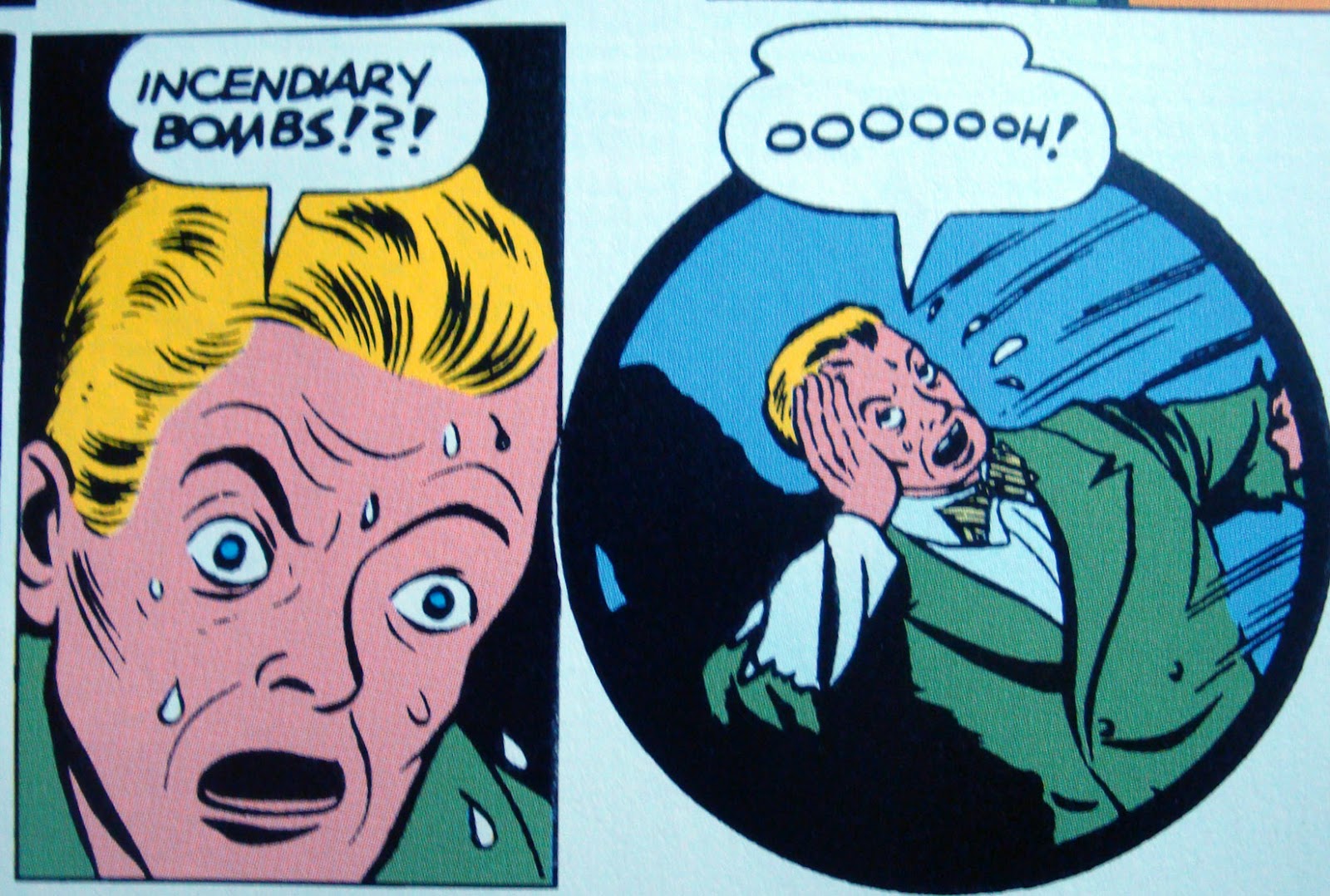
The plan goes fairly smoothly until a raid on the Czech Patriots' headquarters by the Nazis. In order to calm his nerves, Johnny lights a cigarette, and the Nazis suddenly surrender. Once the Nazi's are trussed up, Johnny learns why - he was lighting his cigarette while standing next to the highly flammable material used for incendiary bombs.


A Nazi Captain is experiencing haunting dreams that involve Sandman, along with his sidekick, Sandy the Golden Boy. This is the first time Sandy's made an appearance with the JSA, and personally, I prefer my Sandman stories solo. Then again, I prefer my Sandman in gas mask and trench coat instead of yellow and purple tights, so what are you going to do?

The Nazi Captain has every right to be fearful of his dreams, as even as he awakens, Sandman and Sandy have derailed a Nazi train, and brought food capsules to freedom fighters in Greece

Here's where Sandman's plan gets a bit...weird. After publicly derailing the train, and beating their way through Nazi soldiers, Sandman and sandy tel the Nazi Captain that they have decided to switch allegiances.

Yes. Yes they are fooling you.

And in roughly four panels, with very little persuasive word, Sandman and Sandy have somehow convinced the Nazis that they've switched sides. With no challenges put forth to test their allegiances, they're accepted into the fold, so much so, in fact that with a mere friendly wave, they bid the captain adieu and ask him to send out a message via the Propaganda Broadcasting Office.


Surprise, surprise. The message was really a coded message that let American Intelligence Officers know where an invasion was taking place so that they could stop it. Oh, and Hitler makes an appearance before the chapter's end:


Their individual missions completed, the Justice Society reconvenes, and gives themselves a large round of back patting, except for Johnny Thunder, who's starving and decides to gorge on food capsules, leading to this bizarre exchange with Wonder Woman:


So, not only do they now let her be a full-fledged member of the group, but they also make her watch over the most useless member of the organization? Sheesh, they might as well have made her Den Mother.

Of course, all those food capsules are useless without the solution to make the food solid, which then inspires this brilliant move by Johnny Thunder:


And with that, this JSA adventure comes to a close.

On a historical note, a running theme throughout each story in this issue was the "RAF Bombers," either in mention or action as the planes took down Nazi hangars. In case you're wondering, the RAF stands for Britain's Royal Air Force. If this issue is dated for Dec 1942 - Jan 1943, it likely was on newsstands some months before, at which point, in the real world, the Allies had agreed upon a strategy where Americans would bomb during the day and the RAF at night.


Next up, something I've been looking forward to - the JSA's first encounter with a full-fledged super-villain -"The Brain Wave!" Stay tuned...