Showing posts with label Golden Age. Show all posts

Friday, November 15, 2013

All-Star Comics #23 - "The Plunder of the Psycho-Pirate"

Dated for the Winter of 1944, the cover of this issue by artist Joe Gallagher shows the current incarnation of the Justice Society - Hawkman, Dr. Mid-Nite, Johnny Thunder, Starman, The Atom and The Spectre, all being manipulated by the hands of an unseen villain known only as The Psycho-Pirate. It's a terrific interpretation of the story within, as the heroes find themselves being emotionally manipulated by the criminal mastermind.

In the real world at this time, FDR won an unprecedented fourth term as President of the United States and Hitler exits from his wartime headquarters in East Prussia and heads to Berlin, where he will soon step forth in a bunker from which he will not return.

For the wartime superheroes, The Justice Society, they're maintaining peace and order on the home front and have been called to the offices of Courier newspaper publisher, Mr. Morgan, after the paper received a challenge from a criminal calling himself The Psycho-Pirate. The villain is supposedly behind a series of crime sprees that play off of human emotions, and now, the mysterious criminal is publicly challenging the Justice Society to stop him - no doubt a trap to eliminate them, the heroes deduce.

With the help of Mr. Morgan and his longtime confidant and Linotype at the paper, Charles Halstead, the heroes set out to take down the emotional villain, minus Wonder Woman, who appears on the team roster at the beginning of the story, but makes no appearance in the actual tale.

Hawkman has been challenged to stop a crime using the emotion of love and in this case, it's the love that a father has for his daughter. The father, a wealthy tycoon, doesn't like the slick-talking man his daughter has been going around town with, and it turns out, for good reason. The slick-talker is just a smooth criminal who steals the woman's purse for his lackeys to show the father as 'proof' that his daughter's been kidnapped. While she's out on the dance floor with this scoundrel, his associates are trying to collect a ransom for her from her father. The Psycho-Pirate has taken precautions for this plan, and had the smooth-talker and his men kidnap Hawkman's girlfriend, Shiera Saunders, to keep him too busy to foil the plot (once again using love, both against Hawkman and the father, as the villain's weapon). Luckily, Hawkman escapes a death trap with Shiera just in time to stop the father from handing over the ransom. By the time the daughter comes home from her date, the criminal mess is cleaned up and one of the villain's schemes thwarted.


Hey now!
Hate is the emotional weapon of choice used against Starman, who must stop the running of a hate-clinic, where men pay to take out their aggression and hate against their enemies in duels to the death. When two rival businessman see the other speaking ill of them in the newspaper, both are separately approached to take part in this clinic. Starman sees the real scheme at work - the villain behind the hate-clinic, The Psycho-Pirate, makes off with the fees paid by clients like the rival businessman, and will feel no repercussion because one client will be dead and the other to blame and not likely to tell the truth about it.

A small town is in trouble until Dr. Mid-Nite steps in. Playing upon the fears of the townspeople, The Psycho-Pirate has threatened to release a deadly plague onto the population unless the town pays a hefty ransom. Some people in the town claim to have already started catching the disease - a show of the villain's might. At one point, fear even traps Dr. Mid-Nite, who after taking down one of the Psycho-Pirate's minions making sure no one leaves town, goes into a fear-stricken panic that he may have been contaminated with the diseased germs. Discovering the chemical plant that the criminals have taken over to create and spread the disease, Dr. Mid-Nite makes fast work of them, only to discover that the Psycho-Pirate truly was playing with fear, as the test tubes supposedly carrying the disease are inert and merely harmless colored water. Building fear through the use of actors pretending to have the disease, The Psycho-Pirate was playing the town's bluff.

Conceit is, appropriately, Johnny Thunder's burden. It seems two safe-designers are so confidant that their work is burglar proof, that when they receive a phone call from the lighting company saying they can't get into their own safe, the duo head right over to open it for them and laugh at their own brilliance. However, their arrogance gets the best of them, as The Psycho-Pirate planned on, and allows the criminals who were posing as the lighting company to waltz right into the vault. Johnny Thunder attempts to stop the criminals, but is distracted by how in awe they are of his might as a Justice Society member. So distracted by his conceit and arrogance, Johnny is easily thrown into the vault before he can call upon his magical thunderbolt to help him. Once the safe-designers and Johnny gloomily realize how their conceit has gotten them into this mess, Johnny owns up and says the magic words that bring his Thunderbolt to them, freeing them and nabbing the criminals.

You would never think that The Spectre, as a spirit, would be susceptible to emotional tugging and that may be why writers Gardner Fox and Sheldon Mayer made his chapter more about the greed being used on the victims. Two collectors both own one of a two-piece art collection. When a mysterious man (employed by the Psycho-Pirate) offers each of them to get them the other art piece and complete their collection (for a fee), their greed gets the best of them. The man then tells each collector that he was almost caught stealing the other art piece and that he'll rat them out as paying him to do so, unless they each give him THEIR piece. This leaves both collectors with none and the man working for the Psycho-Pirate with both - until The Spectre puts a stop to it, of course.

The Atom probably has the roughest go of most of the heroes, who is being played like a fiddle through the emotion of despair. Mr. Morgan is delivered a mountain of bad news from his friend, Charlie Halstead - the bank is foreclosing on the paper, the newsboys have gone on strike and his wife is divorcing him. As if things couldn't get any worse, a newsflash on the radio informs Mr. Morgan and the Atom that Justice Society has been captured by the Psycho-Pirate. Morgan collapses on his office couch and The Atom sets out to try and free his friends.

Halstead gives the Atom a note left at the paper by the Psycho-Pirate detailing where he has the JSA held captive. When The Atom arrives at the location - a cave on the outskirts of town - he finds his friends and colleagues walled up behind bars in a makeshift cell with no hope left. One by one, the JSA members tell The Atom that the Psycho-Pirate was too much for them and they've given up the fight. The Atom gives up as well, thinking that if the entire might of the JSA wasn't enough, what good is his pint-sized strength. With no will left to fight, The Atom is quickly captured as well and is about to be gutted, when he finally snaps out of it. He's a Justice Society member and he'll go down fighting, no matter what, he realizes! As he fights his way through the Psycho-Pirate's minions, he learns that the JSA has not been captured at all, and were merely hired henchmen/actors to play the parts and fool the tiny hero. He turns to finally see the man behind it all - The Psycho-Pirate - a face all too familiar to him, but kept in shadows by artist Joe Gallagher. The realization comes too late, as The Atom is shot in the arm and injured, tries to make his way back to the paper and warn the others.

The wounded Atom struggles to get back to the paper and only makes it so far as the newspaper's roof before collapsing to the ground. However, he uses what little strength he has left to shout down the vent the real identity of the Psycho-Pirate - the man who was in the room with he and publisher Rex Morgan for most of the adventure, the man who orchestrated the series of emotional-preying crimes, and the man who is in the room with the Justice Society at that very moment - Linotyper Charles Halstead!!

Revealed for the villain he truly his, Charles Halstead, mild-mannered Linotyper turns out to be jealous of the successful life of Rex Morgan and wanted to use everything in his power to ruin it. As a mere Linotyper, he had no power in the corporate world, so he relied on his knowledge of psychology and emotions to drive Morgan, and the Justice Society for their interference, down. Old Charlie even shows a bit of a bi-polar nature himself, running the gamut of emotions once he is captured.


This issue's art chores are mainly handled by Joe Gallagher, with Stan Aschmeier handling Starman, Dr. Mid-Nite and Johnny Thunder and Sheldon Moldoff handling Hawkman. Moldoff's work is the finest among this trio, but the other two hold their own. I tend to sway back and forth when it comes to Aschmeier's art. Sometimes his simple style and use of darks and shadows can really give his stories a nice stylistic approach. Other times, it just seems very rushed (which, considering the time, I'm sure he was). Johnny Thunder probably suffers the most in the art realm this time around.


As for the story itself, it gets a thumbs up from me. There are, of course, some silly elements that require overlooking (The Atom couldn't tell that the JSA held in a cage were actors and not the guys he works closely with?), but overall, it's was a pretty fun read, even today. Keep in mind that the JSA still has not really run afoul of too many super-villains at this point, making them more of a rarity in comics in 1944, with the exception of Batman and his villains, perhaps. With the exception of The Brain Wave, the one appearance of the King Bee, and The Monster, the JSA has mainly been fighting bank robbers and war saboteurs.

With that in mind, The Psycho-Pirate makes a welcome addition to the JSA's rogues gallery, even if he is just a middle-aged to older man in a vest. Gardner Fox and Sheldon Mayer make him a legitimate threat. Let's give credit where credit is due - Charles Halstead did manage to take on the entire Justice Society and almost bring down a newspaper publisher with nothing more than some well thought out psychology schemes. He gets an "A" in the villain rankings from me.


Friday, July 26, 2013

All-Star Comics #21 - "The Man Who Relived His Life"

This issue is dated for Summer of 1944.

At that time in the real world, D-Day was beginning June 6 with more than 150,000 Allied troops landing on the beaches of Normandy in France and pushing inland.

That summer, in July, Franklin D. Roosevelt will announce that he is running for an unprecedented fourth term as President of the United States.

And the Olympics, scheduled to be held in London this year would never come to pass until 1948, cancelled in 44' due to the ongoing war.

In the world of the JSA, however...

Professor Everson, one of the scientists from the Time Trust that sent the JSA into the future for the bomb defense formula has now called upon the mystery men again to help him. It seems since their last adventure in time, the scientist has been working on a formula to cure an undisclosed disease, "...a disease that annually costs thousands of lives."

The scientist has narrowed his formula to two versions, one that he's pretty sure is the Real McCoy and the other which would surely be fatal to whomever drinks it.

It's sort of like the holy Grail in Indiana Jones and the Last Crusade.

Unfortunately, his lab assistant, a reformed criminal, chooses unwisely and sips the mixture that means a slow death. When the scientist discovers the man, dying and repentant of his sinful life, he calls upon the Justice Society to help set things right.

Just how does one do that? Apparently it involves sending each member of the JSA (minus the Atom and the Spectre) into the past to stop the man from ever committing the regretful acts in the first place. The JSA, apparently with no crime to tackle this week, band together to alter the timestream and this man's life so that he can die with a guilt-free conscious.

"Quickly! Hop into this tanning bed and I'll send you back in time!"

Of course, you would think stopping those actions from happening would mean the man would never be regretful in the first place, thus have no need of the JSA going back in time, etc, etc. But, as with many a JSA tale, you just have to throw logic out the window and go with it.

First Stop - 1904, when, as the narrative caption at the start of the chapter tells us, "Teddy Roosevelt is President...and is wielding his 'big stick.' The Wright Brothers have just succeeded in making the airplane fly...

This is very similar to an earlier device that writer Gardner Fox used in All-Star Comics #9, where a description of each country that a Justice Society member visited on their mission was described in the narrative captions at the start of each chapter, along with what that region is known for economically and in terms of resources.

Future Lab Assistant Joe Fitch is just a young bank teller who gets caught up with the wrong crowd, invited to stop by the club of Sapphire Slim, a gambler. Joe, not having many friends in Brooklyn, decides to check it out, just watching at first, but quickly getting caught up in the addictive game, losing more than just his shirt. In fact, with several thousand dollars owed to Sapphire Slim, Joe is in it deep. So, when Sapphire 'suggest' that Joe simply pass along the combination to the vault at the bank he works at, Joe is stuck. However, a suggestion from the time traveling Hawkman convinces Joe to go along with the robbery just long enough to catch Slim and his men. Together, Joe and Hawkman bring the criminals down inside the bank, and rather than receive a reward, 1904 Joe asks that the reward money be sent to Slim's wife so she can support herself in Jail.

Then, suddenly, in 1944, a mail carrier shows up with a letter than had been sitting around the post office for a while.


I can almost hear the Back to the Future music playing lightly in the background...


Next stop on the time travel agenda - 1906, as "San Francisco seethes with activities, as fortunes are made and lost over night in this town which is still 'wild and wooly.' Women are wearing bustles and men are wearing gaily colored vests and heavy gold watch chains."

Joe Fitch has moved out west and is taking on work in another bank, courtesy of his experience, but it's falling in love with a young showgirl named Lily D'Arcy that will be his undoing. While Lily seems to like Joe, the theatre owner (and politician), "Big Mike" McCullum has his eyes on Lily too.

When Lily, out of fear that Big Mike will harm Joe unless she does otherwise, Lily breaks off her relationship with Joe to marry Big Mike. Angry and bitter, Joe pulls out a Dillinger, ready to march into the theatre and kill Big Mike. It also makes matters worse that Big Mike's political rival is filling Joe's head with thoughts of standing up to Big Mike. Fortunately for Joe and his future, The Sandman has landed in 1906 and tries to talk some sense  into Joe. It's no use though, and Joe heads out to the theatre, only to be pounced on in the balcony by a Sandman, desperate to keep Joe from ruining his life.


Big Mike dies that night, but not at Joe's hand, at the hand of his political rival. However, the only one who knows this is Sandman, and Joe flees the theatre and the state in a mad dash, thinking he just killed Big Mike. The only option, Sandman estimates, is to return to 1944 and tell Joe what happened.


The story apparently makes the rounds from Sandman's lips to Joe's ears and the ears of some media outlets because, without much explanation, an elderly Lily reads the newspaper to find a story clearing Joe's name all these years later for Big Mike's murder. Feeling she was always right about old Joe, she sets out to find him.

Starman finds himself in 1914, where "the entire world is about to plunge into the fiery holocaust of the first World War..."  and Joe Fitch, still running from his past, has turned up in Mexico, helping Pancho Villa and his revolutionaries.Villa has charged Joe with blowing up the Horseshoe Saloon, whose owner is believed to be spying on Villa and his men.

While Starman does his best, he can't quite convince Joe not to go through with dynamiting the site. Starman even thought he took measures to make sure the dynamite sticks Joe was using would be inoperable, only to find the saloon still blown to smithereens. Hearing the voices of those dying in the saloon, Joe makes a run for it. Discovering that it was not Joe, but a pair of vindictive drunks who had been tossed out of the saloon a one time too many who actually blew the place up, Starman brings the two to justice. He unfortunately finds no sign of Joe to let him know he did not actually cause the explosion that killed all those people. In fact, Starman's plan DID work and the dynamite Joe tried to use was filled with nothing more than sand.


Finally! I'm just glad to see SOMEONE finally make reference to what these guys are wearing.


As World War I, or The Great War, is in full swing, Joe Fitch finds himself on the battlefield, suffering from a form of shell-shock that sends him reeling whenever there are explosions on the field. It sends him into a panic, still haunted by the saloon. While a lot of these Golden Age comics can sometimes come off as simplistic, and in certain instances, rightfully so, as this story moves along, so does its pathos, and Joe's haunted past comes through in a very sad way. Like an angel out of the darkness, though, Dr. MidNite appears through the timestream and onto the battlefield to help.


Joe tries to get re-assigned due to his debilitating issues with the sounds of explosions, but is told it is impossible, as a large advancement is being made soon and every man available will be needed. When the Germans open up their field guns, it seems like poor Joe may end up insane from fear:


Joining Joe on the battlefield (how does that happen with no one noticing or questioning?), Dr. MidNite points out a grenade that is about to injure a fellow officer, unless Joe puts his fears aside and does something. In that moment, Joe somehow gains complete control over himself, intercepting the grenade and sending it back to the enemy lines.


And with that, the future suddenly changes. That army lieutenant who previously was wheelchair-bound in an army hospital, suddenly gets up and walks, his condition up to this point described as nothing more than shell-shock, that he could walk all along. As the caption reminds the reader, though, we know better.


This Dr. MidNite chapter is my favorite of the entire tale so far, and that's saying something in a Golden Age tale that's turned out to be truly impressive all around.

Fast forward to 1924, when Calvin Coolidge is President of the United States, Jack Dempsey is the undisputed heavyweight champion of the world and Prohibition is in full swing, leading to speakeasies, rum-runners and organized crime.

It's here that Joe Fitch finds himself working for a crime boss who is setting Joe up for a big fall. It seems there is a reporter named Nason who knows too much about this crime boss and his real-life activities versus the society image he likes to portray. By getting the reporter and Joe together, the crime boss hopes Joe will take the fall when the reporter winds up dead. It turns out, though, that the reporter knows quite a bit about Joe's background as well. Still fearing that he killed all those people in the past, Joe goes into a panic, and might have killed the reporter too, if it weren't for the intervention of Dr. Fate, once again forsaking his mysticism roots for a good one-two punch and in some great art by the legendary Joe Kubert.


In 1932, Joe finds himself doing dirty work for a crooked politician running for mayor. With the intervention of a time-traveling Johnny Thunder, though, Joe is convinced to let an honest man win the election; a man who, as we move through time, becomes a Senator in Washington, fighting against corruption.

As the Justice Society begin to make their way back through the timestream and to the present of 1944, they stand around Joe's bedside, letting him know the good he did in his life. As they bring him up to speed, Joe already feels the changes within him as his life takes on new shape due to the interference of the time traveling Justice Society.


When Lily, his love from the Saloon days of 38 years prior, arrives at the hospital, she insists upon a bedside wedding so that she and Joe can finally be wed. As he takes his last breaths, Joe Fitch dies a happy man, knowing he did good with his life, even if it took him decades to correct the mistakes he made. As Hawkman reminds us, everyone makes mistakes, but it's realizing it that is the first step to being a good person.


When you get over some of the pseudo-science involved (and when it comes to comics, you SHOULD just let your imagination go), this was a truly heartfelt story about redemption. Whether it resonated with the young folks reading comics in 1944, I'm not sure, but it certainly ranks up there as one of the better Golden Age stories I've read, and definitely a contender for top ten material when it comes to original JSA stories.


Sunday, December 18, 2011

Artist Irwin Hasen profiled in New York Times

In case you missed it, Golden Age Green Lantern and The Flash artist, along with co-creator of the character, Wildcat in the 1940s, Irwin Hasen, was profiled by the New York Times.

A great read and well worth a look.


http://www.nytimes.com/2011/12/18/nyregion/for-irwin-hasen-a-life-with-dondi.html


The artist Irwin Hasen in his Upper East Side apartment.                                                  Julie Glassberg for The New York Times

Wednesday, June 8, 2011

All-Star Comics #11 - "The Justice Society Joins the War on Japan!"


Well, that anti-air bombing formula obviously didn't work...because between last issue and this, Pearl Harbor has been bombed and America has entered World War II.

With the Japanese bombing of Pearl Harbor, many have been killed and even more wounded, crippling America's air fleets based in Hawaii. It is for this very reason that the JSA comes together for their regular meeting under a cloud of grief and guilt. Despite the spy rings they've smashed, the saboteurs they've put away, none feels that he has done enough to help his country.

Each one ashamed to say what they're thinking of doing next, Hawkman takes the plunge, and explains that as his everyday identity as Carter Hall, he is enlisting in the U.S. Army. When the other take great joy in this, Hawkman takes a bit of defense that they would want him out as their chairman so gleefully. However, they quickly divulge that they were each looking to enlist too.

Except for Johnny Thunder, who is planning on joining the Navy, and The Spectre, who has his own problems...


Hawkman, appropriately enough, takes to the skies, and becomes a pilot for the U.S. Services, and finds that Hawkgirl - Shiera Saunders - is also doing her part for the good ol' U.S. of A., by becoming a nurse. When the two run into each other on base, Carter Hall takes a look at the nurses list and reveals a bit of a surprise to Shiera.

The Justice Society has been spying on you for some time, Diana...in a non-pervy way...well, with the exception of Johnny Thunder...

When a convoy comes under attack by the Japanese, the pilots take to the air, and Carter Hall finds himself more useful as Hawkman than as a pilot, and drops bombs from above, the old fashioned way.

And come on, check out that awesome Joe Kubert art...


When Diana Prince learns that there's a little skirmish on the coast near Vigan, she hops a ride with the medics and springs into action as Wonder Woman, fighting back the Japanese forces.

1940s-era racism and sexism, all rolled into one great panel.

Needless to say, Wonder Woman not only cleans up the beach of the Japanese troops, she single-handedly takes them down at various points all across the island, putting the men in uniform to a bit of shame. But, they must really dig her outfit, because after she mopped the floor with the enemy for them, they ask her to become a member of the detachment.


Over on Wake Island, Wesley Dodds ditches his Sandman persona to serve the cause on a marine garrison, learning to fire the anti-aircraft cannon on the shift. Bored with the slow process of his by-the-book training in the service, Wesley sneaks out of his bunk at night and 'borrows' a captured Japanese submarine.

Seriously? No one noticed a guy in purple and yellow spandex stealing a submarine off a U.S. Carrier?!

Wesley then uses the telegraph in that sub to tell all the other Japanese watercraft to scatter, warning that American fleets are closing in...and they all listen.


With obviously plenty of time left in the night, Sandman then sneaks aboard a Japanese carrier and sets fire to all their planes.


Of course, the U.S. Servicemen feel a bit cheated, and drop this note to Sandman from above...

That selfish bastard.

Al Pratt, aka The Atom, is on the front lines, manning tanks. However, once in the thick jungles, he decides to give the American troops a little advantage on the battlefield, by pulling this old stunt:

"Battle tanks! Now made with a new, lightweight metal for that east to grasp tip-over! They're a cinch to lift! Order now!"

Dr. Fate's alter ego of Kent Nelson has volunteered for the Parachute Troops, which, really is not all that daring considering the fact that he can fly. Not much to his adventure - just a lot of punching and crashing through walls. Once again, it seems either the writers, or the editors (ordering the writers) forgot or chose to ignore the fact that Dr. Fate is a being of all-powerful magic. Here, he serves as pretty much a substitute for Superman - invulnerable, flight and super strength, beating up on the enemy.

You didn't think of it because you were too busy wielding the power of the universe in your hands up until about four issues ago.

Dr, MidNite, meanwhile, is forced with the dilemma of wanting to enlist, but not giving away the secret that he can, actually see in the dark courtesy of his special goggles. He fears that he has no chance of enlisting due to his blindness unless he admits his advantage as Dr. MidNite. Just as he is about to confess the truth to his assistant, he receives a call that he is needed by the armed services to work on a formula by a scientist whose life was cut short by a bombing.

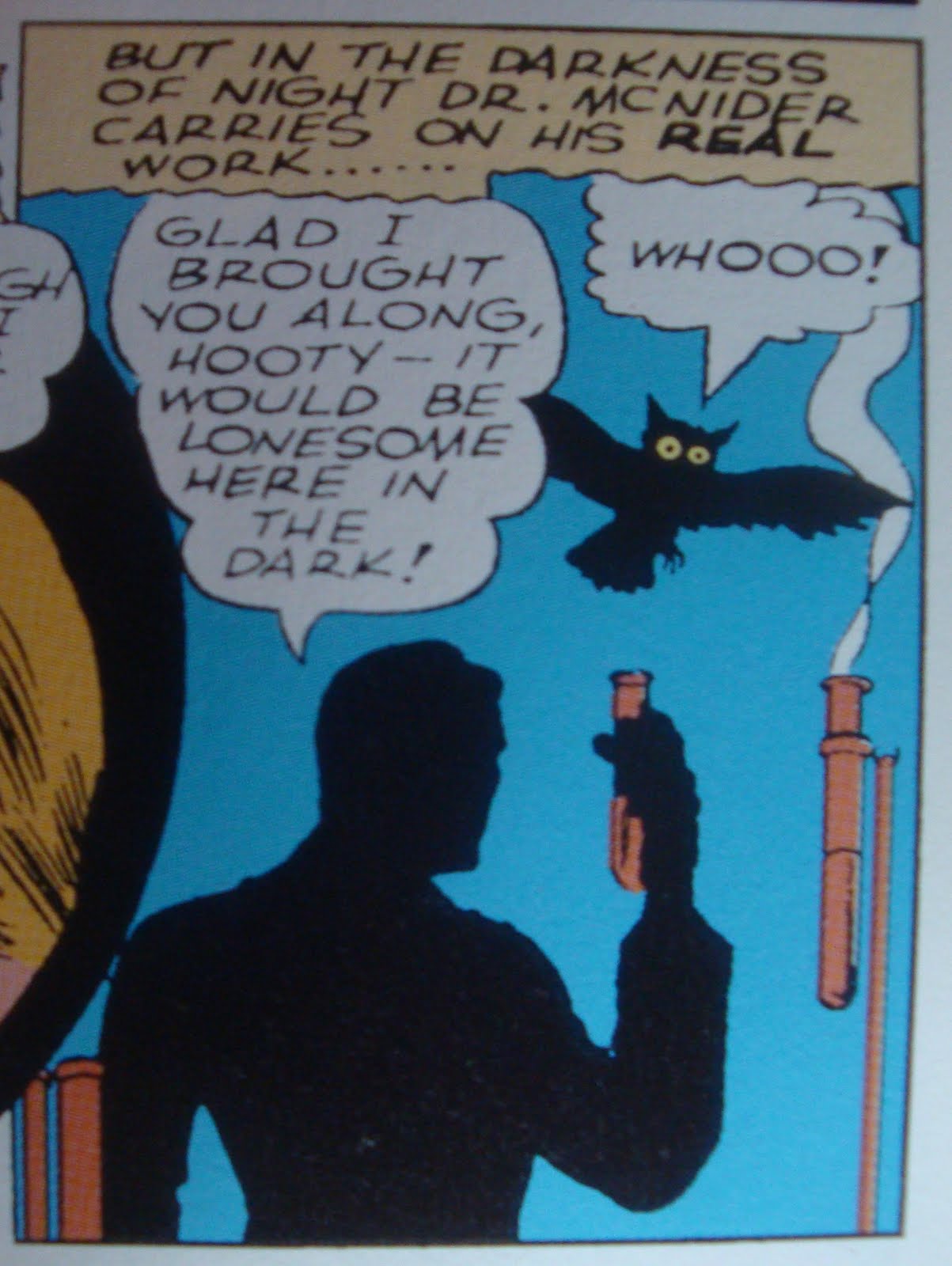
Arriving in the Pacific, Charles McNider gets right to work on the formula, and it appears his assistant, Myra isn't the only one he brought along...

I don't want to know where he hid Hooty for that entire plane ride to sneak him past both Myra and the servicemen.

Of course, it's not his work as Dr. McNider that takes precedence when Japanese fighters attack, and McNider springs into action as Dr. MidNite, shining a light on enemy planes that are headed toward their area. Shining spotlights on the fighters, MidNite draws enough attention to get the planes shot down before they can do further harm.


Ted Knight has joined the Air Force, meanwhile, only to find that he's got the worst co-pilot to bring along on his mission...

"Should not have eaten...in the mess hall"

It doesn't take long before Ted finds himself the target of enemy fire, and with his co-pilot passed out, he makes a quick change to save he and the other pilots up in the air. Ordinarily, I'd have some kind of comment about having the time as the plane is going down to change into your costume, but, I'm just so much more forgiving when I see this beautiful Jack Burnley artwork...


Not even magnetized bullets that find their way right to the engine are a match for Starman, who issues a stern warning to the Japanese after he takes down the fleet.


And, of course, finally, there's Johnny Thunder, who has enlisted in the Navy. Sidenote, we find out many, many years later, in the 1990s Justice Society revival series, that Johnny remained in the Navy right through wartime.

However, here, Johnny has a bit of a rough start - getting in the way of his colleagues, and even a plane here and there. It's so much trouble right off the bat, that his commander wishes he could transfer him to the enemy.

Even the higher-ups know Johnny is a screw up, and decide it's best to just have this kid do whatever menial task they can find, rather than send him into battle and put actual reliable servicemen at risk.

Of course, as is Johnny's constantly dumb luck, those menial tasks meant to keep him out of harm's way, put him right in the path of a saboteur, who is trying to do damage to the carrier Johnny is stationed on. Placing a hammer inside some machinery to gum up the works? Sorry, saboteur, Johnny needs that hammer to hang the Captain's picture frame. Going to start a fire on the ship? Sorry, saboteur, but Johnny needs those matches to light the Captain's cigarette. You get the picture. Oh, and wait...that's no lighter...


Having been declared a hero for thwarting so many sabotage efforts, the higher-ups decide Johnny might be worth keeping around after all.


Oh, how they are so easily fooled. THIS kid on the front lines? How did we ever win WWII?

It seems the U.S Government thinks the JSA did TOO good a job on the battlefield (did they even read the Johnny Thunder story?!) and rather than take the fighting away from the boys of the USA, to become a special branch of the government during wartime, to accept special missions vital to the war effort.

The JSA even decides that it's time to let Wonder Woman in full time. Too bad they decide one of the most powerful heroes on Earth should be their secretary. Oy!


Saturday, June 19, 2010

All-Star Comics #6 - The JSA initiates Johnny Thunder

The Flash is stepping down as an active member of the JSA in order to put his attention toward "more pressing duties." What seems to be the trend with the JSA is that as soon as one of the heroes receives their own comic title, and are no longer just a part of a team or anthology book, they move to "reserve member status."At this point in comic publishing history, The Flash has just gone from being one of the multitude of heroes in "Flash Comics" to also starring in a book completely his own, called "All-Flash."

Sort of raises a question about the character's self-awareness. Are they aware that they're nothing more than fictional comic characters? Sort of a metaphysical thought for 40s comics, and I'm sure no one really dwelt on it back then. But it's the sort of thing Grant Morrison would have had a field day with today.


Either way, the JSA members have put out a full spread to say goodbye to their friend, The Flash as an active member.

Of course, what's a party without a party crasher...in this case, Johnny Thunder.

For the past five issues, Johnny Thunder has been an outsider when it comes to the Justice Society of America. While the rest of the team boasts fantastic powers and prowess, poor Johnny is just a hapless, naive young man, with a good heart.

However, the bow-tied blond does have some ability to his credit - raised on a Bahdnesian island, a ritual held over him when he was a baby gave him the power to control a mystical "thunderbolt" - kind of like a magic genie. The only problem for Johnny is that he's completely unaware how he controls this power. It's put to use when he says the phrase "Cei-U," which sounds like "Say you" in English.

Needless to say, the writers often find someway for Johnny to work the phrase into his dialogue in the nastiest of situations, thus always unwittingly calling upon his thunderbolt to help him out of tough spots.

Well, now Johnny insists (at the behest of his girlfriend, Daisy, no less) that it's time he become a full-time member of the JSA. Boy, that Daisy sure is something. If she isn't complaining about how Johnny isn't smart enough or rich enough to date her on a regular basis, she's convincing him to go pound down the door of some super-heroes and insist he join their team. What a gold digger.

And as tried and true heroes do, they let Johnny know that he's out of line.

So, you're facing down the most powerful beings on the planet, interrupting a celebration for one of their closest and founding members, and you've just been told that you're stepping way out of line.

What's the best possible thing to do at that moment?

That's right. Try to use the one power you have to FORCE these heroes to let you in. Smart.


Needless to say, the members of the JSA are pissed that Johnny just tried to use magic to convince them to let him in the group. So, who can blame them when they decide it's time to teach Johnny a lesson in humility.

The JSA decides that maybe they can have a little fun with Johnny and tell him that as part of his initiation, he'll have to bring in "Killer" McPanzee, a criminal who seems to have made quite a few headlines. Eager Johnny is quick to agree, and heads out to capture the crook. Once gone, the JSA members have a good laugh at his expense, as McPanzee is nothing more than an old man who dreams of being a feared criminal and prints out his own headlines on a printing press.

It's kind of hard to put your faith into a group of heroes who put so much time into laughing at and causing trouble for their less intelligent members. But, at the very same time, I quite enjoy how the the early JSA was more of a fraternity than a super-hero group.

While the heroes laugh off Johnny's initiation, Johnny finds himself over his head - surprise. While Killer McPanzee may not be a threat, he has been shaken down by real criminals who want to use Killer's pathetic persona as a front for real crime operations. Who would suspect the desperate man making his own newspaper headlines would actually have a real connection to the underworld.

Johnny's big plan is to sneak into McPanzee's home in disguise, and then hand him over to the authorities, disguised as what appears to be a college graduate. So, dressed like a graduate from Bad Mustache University, Johnny heads over to McPanzee's, only to find REAL gangsters have beaten him there. Worse yet, they see right through his graduation gown disguise. Faced with some of the most ruthless gangsters of the town, Johnny shows just how courageous he would be as a JSA member...telling them exactly why he's there.

Naturally, this leads Johnny into a boatload of trouble - being placed into a burlap sack by the gangsters and tossed right into the river. It's only by accidentally saying those magic words "Cei-U" that he escapes from drowning and The JSA members are alerted, one by one to the fact that he's in trouble.

Thus begins another round of framework for a story that gives each JSA member the chance to have a small solo adventure while on the hunt for Johnny Thunder. In the case of the Flash, he follows the gangsters leaving Killer McPanzee's house, only to stumble across a counterfeiting ring. Using his powers of super-speed to move the pens and equipment of the counterfeiters, Flash gives the criminals exactly what they want - a little too much, in fact.

So much counterfeit money has been created thanks to the Flash's super-speed efforts, the gangsters quickly go from elated to frightened, when the money nearly drowns them in their own hideout. It draws a lot of attention from those passers-by in the neighborhood, and I love how these two citizens so quickly go from excited about free money to disgusted about counterfeitting.


Once the counterfeiters are safely behind bars, The Flash realizes while he was distracted by the counterfeit ring, he failed to locate Johnny Thunder. Well, having escaped from drowning, Johnny is just about to give it all up. and uses his powers to wish for the first thing on his mind.

Oh, Johnny...always thinking with your penis...

Naturally, spending the day trying to work it on Dr. Fate's girlfriend comes with its own risks. In Johnny's case, he gets mixed up in a plot by some criminals who are well-aware that Dr. Fate and Inza are tight, and plan on luring Fate into a trap by kidnapping his main squeeze. Johnny? Well, as always, Johnny just gets in the way...and shows much courage in the face of danger...by hiding in the trunk of Inza's car, which is driven right into the criminals' hideout. Meanwhile, Dr. Fate comes to Inza's rescue and takes down a group of racketeers working out of an auto mechanics garage. When the gangsters can't find a way to step up to the ancient magic of Dr. Fate, the hero/sorcerer's inner-pyro, seems to bubble to the surface.

As Dr. Fate watches the racketeer's hideout burn to the ground, a frightened Johnny escapes from the trunk and continues his brilliant plan of retreat by jumping down the building's laundry shoot. From there, Johnny finds himself in a myriad of bizarre situations - from a horror-house with men running around dressed as skeletons, to an illegal casino...none of which warrant much detail other than a mention. Each mishap is just another method for the writers to bring in another hero as they "search for Johnny" while having a solo adventure of their own.

Of note in these adventures is The Spectre, who, while searching for Johnny comes across a man being attacked by a creature with no head. I find it of note for a few reasons. The first being that, as I've mentioned many times before - The Spectre is a ghost! So why is this almost all-powerful being wasting his time looking for the JSA's mascot? I still can't fathom that one out.

As always, The Spectre's adventure is always the most bizarre of the Justice Society members.

Worth a mention here is that it seems someone in the art department may have been out of the loop with the bigger picture of this story...as the man Spectre saves from these creatures is drawn and colored an awful lot like Johnny Thunder, complete to the color of his suit, tie and hair. The only difference is the thinly drawn (and I'm guessing late-added) mustache.

Maybe that's why The Spectre felt drawn to the man...because the man, named Bob Randall..is drawn just like Johnny Thunder!! But I digress. It seems Mr. Randall has been attacked by these headless creatures while spending time with his fiance, Jean. The only common link? A creepy little man who Bob says has been staring at Jean from the bushes of the park whenever she walks through.


Well, like any good sociopath and sexual predator, the odd little man already feels he has some sort of relationship with Jean, and expects some of kind of return favor for paying so much attention to her...from behind...the bushes.

When she refuses to give him a little sugar, the man kidnaps her and forces her to call Bob to come rescue her. When Bob comes charging to her aid, he is attacked by yet another headless creature. It appears the strange little peeping-Tom has somehow taken ordinary men and turned them into these headless slaves, and plans to do the same to Bob...while Jean is forced to watch. The little man then insists that once Bob is under his control, he'll use him to force Jean to be his. Sick little perv, isn't he?

Well, if there's one person who deserved a good dose of justice, it was this little man. And who better to dish it out than The Spectre, who destroys the headless henchmen while Bob, having been freed from his chains by The Spectre, now pounces on the little man, taking him down a flight of stairs. When the fight is over, the little man is dead - and The Spectre doesn't bat an eyelash.

Who knew The Spectre was such a romantic?

While his fellow JSA members head out to find Johnny, falling into their own mini-adventures, The Green Lantern finds himself bored, and decides it's time to put his efforts into the search for Johnny Thunder. Like many of his colleagues throughout the story, Green Lantern quickly gets sidetracked - this time by hijackers, who GL witnesses murder a truck driver and take off with the truck and its contents. Though, oddly enough, it's never once mentioned what the contents of the truck are.

The hijackers - not surprisingly - are no match for Green Lantern and his magic power ring, and are quickly overpowered. While transporting the criminals to police headquarters, though, GL notices a strange sight in the air around him. - Johnny Thunder, who, surprise, has gotten himself into more trouble.

Wow...for someone who just described Johnny's predicament as "hanging on for dear life," Green Lantern has no problem just walking away. So cold. So very cold.

To find out just how Johnny got into the predicament, the reader is thrown back in time a little bit, to when Johnny got thrown out of that illegal casino earlier in the story. It turns out when Johnny was thrown out of that casino, he got so fed up, he just wanted to fly away.

Man, what a baby.

Wow. So, apparently, the way to get into the Justice Society is to throw yourself a pity party.

Once again through his witless wishing ability, and the magic of his thunderbolt, Johnny is rescued, and plopped right onto the deck of a ship in the middle of the ocean. It's not just any ocean liner, though. Naturally, Johnny's uncanny knack for staying alive every time he gets in over his head has landed him on the very ship that some gangsters have kidnapped Shiera Sanders. That's right - Hawkman's girlfriend just happens to have stumbled onto a large inheritance.

And some gangsters who were snooping outside of the estate reading want a piece for themselves. So, they've taken Shiera hostage until she pays her own ransom.

You know, with Johnny and Shiera's abilities to get in to trouble each and every month, it's surprising these two never got together. But then, I think Johnny would pretty much soil himself on the spot if a jealous Hawkman showed up on his doorstep.

After rescuing Shiera from the sea-bound criminals, Hawkman flies her away, leaving Johnny to take care of the rest. That's right. The hero who actually has some kind of special ability is leaving the idiot in the bow tie to clean up the rest of the ship's crooks on his own.

Hawkman. Winged Warrior. Chairman of the JSA. Dick.

Johnny holds his own, it turns out, with the help of his magic thunderbolt, of course. Johnny gets so pissed about being the butt of everyone's adventures that he orders his thunderbolt to mop the deck with the criminals on board. Then, who should he find out at sea but Killer McPanzee - whose capture would mean JSA membership for Johnny. Sure, Johnny may be an idiot, but can you blame him for being so angry when he's just walked over by hero and villain alike?

Johnny brings the JSA Killer McPanzee as requested. In fact, with the help of his magic thunderbolt, he brings them the whole damn ship - right outside their brownstone headquarters! Realizing that even for a dimwit, Johnny never seems to give up, and somehow manages to get the task done, the JSA votes to install Johnny Thunder as a full-fledged member of the group.

Of course, that still doesn't do away with the giant ship outside of the brownstone. With Johnny's once a day limit of one hour of thunderbolt magic used up, you'd think his initiation to the JSA would be short-lived.


Nope.

He just rolls up his sleeves and gets ready to take the ship apart by hand.

Say what you will about Johnny Thunder - the kid's got balls.